
Compute Deflation and the Shifting Frontiers of Hyperscale Capex
Assessing inference unit economics, semiconductor equipment bottlenecks, and physical infrastructure constraints across the compute stack.
The contemporary semiconductor and hyperscale landscape is characterized by a fundamental tension: an unprecedented collapse in marginal compute costs paired with relentless capital expenditure across the physical supply chain. While macroeconomic headwinds and energy input costs continue to compress margins in transport and legacy industries—exemplified by airline operators absorbing severe fuel-driven forecast cuts despite peak top-line throughput—the digital infrastructure complex remains locked in an aggressive capacity race. Simultaneously, capital allocators must navigate idiosyncratic balance-sheet shocks, such as historic regulatory penalties in big tech, alongside sentiment volatility surrounding next-generation cloud providers.
Inference Unit Economics and the Jevons Paradox in Compute
As illustrated in quantitative tracking of architectural generations, the operational economics of inference workloads have undergone radical structural transformation. The marginal cost to generate one million tokens has declined from roughly $32.50 in early foundational models (Gen-1, 2023) to under $1.80 in Gen-4 (2026), with projections tracking toward sub-$0.50 levels by Gen-5. This cost deflation is mechanically underpinned by a steep non-linear expansion in energy efficiency, rising from approximately 80 Tokens per watt-hour to more than 2,700 Tokens per watt-hour over the same window.
Hyperscale Compute Scaling: Inference Unit Economics
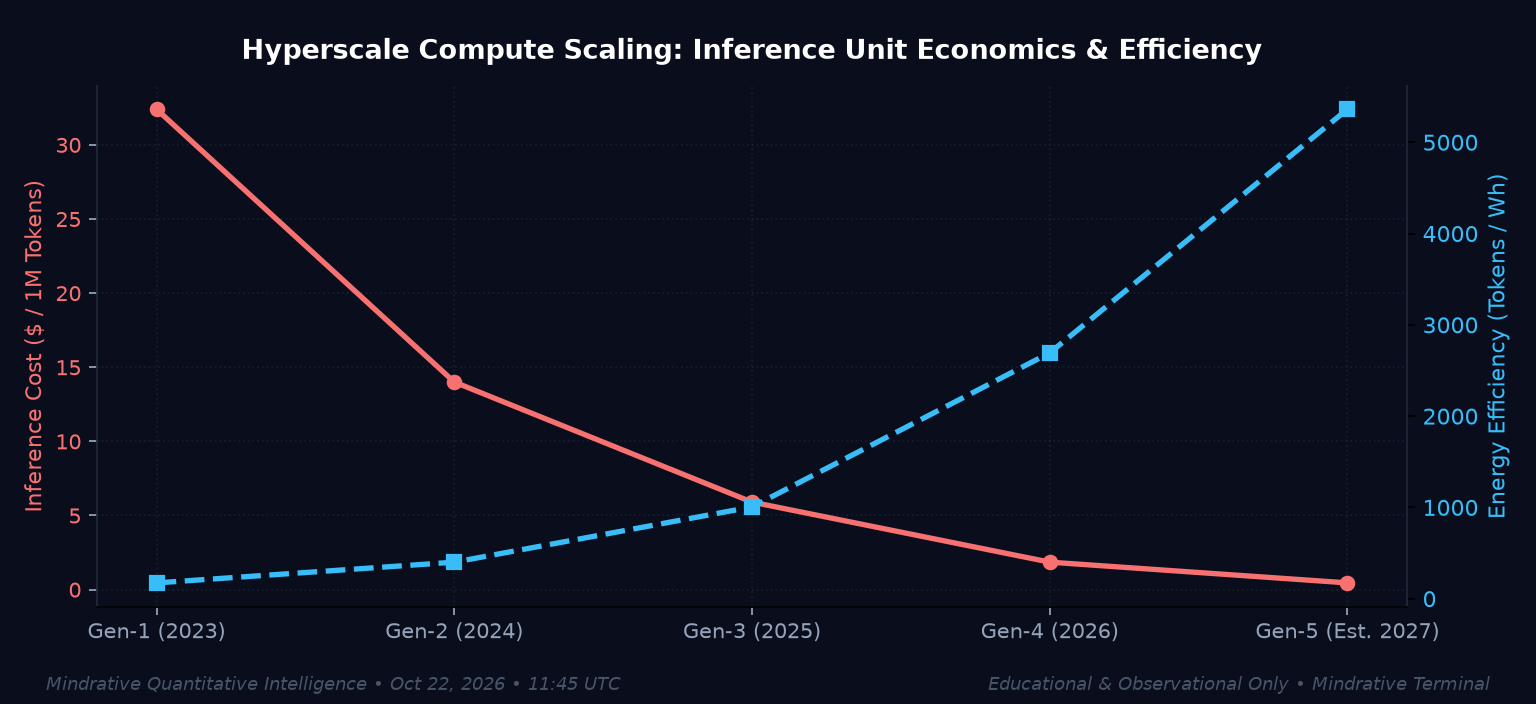
From an econometric perspective, this dynamic exemplifies Jevons Paradox: rather than reducing aggregate hardware and power consumption, steep reductions in unit inference costs have unlocked latent enterprise demand across reasoning architectures, real-time agentic workflows, and synthetic data generation. Consequently, aggregate compute consumption has outpaced per-unit efficiency gains. This operational paradigm keeps aggregate compute demand highly sensitive to sovereign-scale clusters and neocloud availability, where marginal comments on capacity allocations can induce severe factor volatility across specialized infrastructure operators.
Physical Bottlenecks and Upstream Equipment Divergence
While workload efficiency expands at the software and silicon interface, upstream hardware and civil engineering layers exhibit distinct friction points. The recent moderation in forward outlooks from key wafer fabrication equipment (WFE) manufacturers, including Lam Research, highlights cyclical digestion periods in tool installations and foundry tool retooling. As fabrication transitions toward gate-all-around (GAA) architectures and advanced packaging topologies, lead times and capital thresholds expand materially.
Simultaneously, the physical footprint of artificial intelligence infrastructure is reverberating through non-traditional industrial segments:
- Civil Infrastructure & Specialized Coatings: The rapid buildout of high-density server halls has catalyzed acute demand for specialized industrial coatings, thermal barriers, and structural materials essential for airflow management and static prevention.
- Grid Interconnection Constraints: Substation transformer backlogs and thermal cooling supply chains represent structural governors on deployment velocity, decoupled from silicon availability.
- Semiconductor Tool Cycles: Equipment suppliers face uneven booking profiles as tier-one fabricators balance memory module buildouts against leading-edge logic capacity additions.
Capital Allocation Discipline Amid Structural Balance Sheet Friction
The imperative to sustain multi-billion-dollar infrastructure outlays is increasingly tested by exogenous capital demands. The imposition of historic regulatory liabilities—such as Meta’s $25B settlement related to legacy data privacy litigation—serves as a reminder that enterprise free cash flow buffers face non-operational calls on capital. For mega-cap operators, absorbing sovereign-scale penalties while simultaneously funding next-generation cluster procurement requires rigorous liquidity management.
In aggregate, the quantitative regime across technology infrastructure is evolving from speculative capacity acquisition to an era governed by power availability, inference unit economics, and physical execution. The dispersion between raw equipment orders and operational data hall capacity suggests that aggregate capital allocation will increasingly reward structural efficiency over brute-force silicon scaling.
Informational only — not financial advice. This digest interprets publicly available information and data for educational purposes and does not constitute a recommendation to buy, sell or hold any financial product. Verify sources and consider your own circumstances before making financial decisions.