
Macro Yield Recalibration and Term Structure Divergence
Assessing sovereign yield curve shifts, debt issuance velocity, and policy paths amid persistent inflation frictions.
Sovereign debt markets and multi-asset capital structures are navigating a pronounced repricing phase as central banks approach pivotal policy determinations. Market participants face a macroeconomic landscape characterized by divergent term premia, sustained consumer cost pressures, and an accelerating volume of corporate debt issuance driven by large-scale capital expenditure initiatives. Rather than a synchronized easing across sovereign curves, quantitative observations reveal an uneven recalibration of rate expectations across short-to-intermediate durations alongside persistent long-end volatility.
Sovereign Term Structure Repricing and Curvature Dynamics
The sovereign yield benchmark illustrates an asymmetric shift over the past month, marked by distinct pockets of duration pressure and localized curve inversion. Front-end and intermediate tenors—most notably the 3-month (+14 bps), 6-month (+17 bps), and 1-year (+20 bps) obligations—have experienced substantial upward repricing. This reflects shifting probability distributions around policy rate adjustments and a higher-for-longer policy trajectory maintained by the Federal Reserve.
Sovereign Yield Curve Snapshot & Term Structure
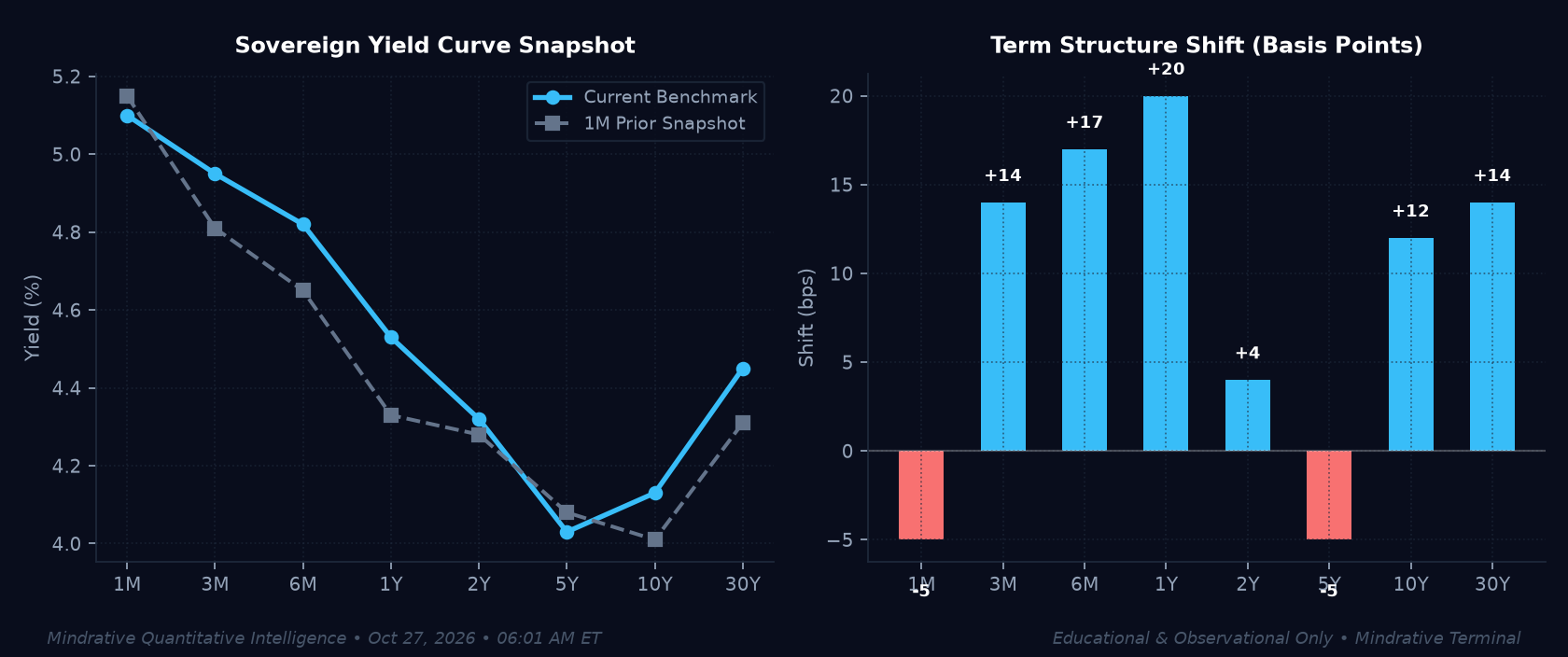
Concurrently, the intermediate belly of the curve displays non-linear behavior: while the 2-year yield rose modestly (+4 bps) and the 5-year eased (-5 bps), long-duration yields reconstituted their risk premium, with the 10-year (+12 bps) and 30-year (+14 bps) moving upward. This dual expansion at the front and ultra-long segments points toward two parallel mechanisms:
- Short-End Policy Pricing: Sticky headline inflation readings and structural consumer frictions constrain monetary authorities from pursuing aggressive rate-cutting trajectories.
- Long-End Term Premium Expansion: Persistent fiscal borrowing requirements, heightened sovereign debt issuance, and elevated duration risk require higher structural yields to balance institutional balance sheet absorption.
Capital Formation Pressures and Macro Factor Linkages
The shift across sovereign yields intersects directly with broader credit dynamics and capital allocation across corporate balance sheets. Corporate credit markets are absorbing elevated supply as institutional debt desks finance accelerated infrastructure outlays, notably across technology and compute infrastructure. The willingness of institutional debt markets to intermediate high volumes of corporate debt reflects liquid private and syndicated debt capacity, even as underlying benchmark financing costs remain elevated.
Simultaneously, microeconomic friction points are becoming increasingly prominent in consumer-facing sectors. Heightened regulatory scrutiny over pricing integrity and retail margins underscores the lingering impact of cumulative cost-of-living adjustments on household balance sheets. As pricing transparency receives elevated legal oversight, aggregate demand elasticities may begin to compress margins across defensive and retail segments, reinforcing cross-asset performance dispersion.
Institutional Trajectory and Cross-Asset Implications
Heading into forthcoming central bank policy communications, cross-asset correlations remain sensitive to adjustments in policy language, forward guidance, and balance sheet runoff mechanics. Equity multiples in growth-sensitive sectors continue to demonstrate resilient beta, buoyed by secular capital investment themes, yet remaining vulnerable to long-term discount rate re-evaluations.
In summary, the sovereign curve's current morphology highlights a regime where term premia are structurally non-zero and macro uncertainty remains concentrated along the edges of the policy path. Monitoring curvature shifts, debt syndication clearing spreads, and real yield movements will remain essential for evaluating structural asset dispersion across global capital markets.
Informational only — not financial advice. This digest interprets publicly available information and data for educational purposes and does not constitute a recommendation to buy, sell or hold any financial product. Verify sources and consider your own circumstances before making financial decisions.