
Volatility Compression and Industrial Dispersion Across Factor Regimes
Examining ultra-short-dated volatility suppression, industrial policy frictions, and cross-commodity momentum dispersion.
Global asset markets are currently exhibiting a pronounced dichotomy between implied index stability and heightened underlying cross-asset dispersion. While broader benchmark volatility measures reflect structural suppression driven by systematic yield-harvesting mechanisms, industrial and energy complexes are pricing significant geopolitical, regulatory, and microeconomic reallocations. Understanding the transmission channels between trade policy interventions, systematic options flows, and commodity factor divergence is essential for institutional market observers.
Microstructure Dynamics: Systematic Compression in Short-Dated Volatility
A defining characteristic of the prevailing market regime is the divergence between macroscopic index tranquility and idiosyncratic sector churn. In equity derivatives, institutional and retail participation in zero-day-to-expiration (0DTE) contracts has increasingly clustered around volatility-selling strategies. Systematic delta-hedging flows associated with these short-dated option structures generate reflexive feedback loops, dampening intraday headline index variance and anchoring broad benchmarks like the S&P 500 within tight statistical bands.
However, this index-level compression masks substantial variance at the constituent level. Telecommunications and defensive equities, exemplified by Verizon’s divergence between operating revenue and subscriber acquisition metrics, illustrate an environment where cash-flow visibility is rewarded while aggregate top-line elasticity remains constrained. Concurrently, capital reallocation across cyclical and defensive sectors reflects an uneven pass-through of financing conditions, preventing broad-based factor coordination.
Commodity Price Momentum & Implied Volatility Surface
Trade Policy Reconfiguration and Industrial Structural Headwinds
Cross-border industrial policy has introduced friction into multi-regional supply chains, particularly within core manufacturing hubs. The automotive sector in Germany highlights the operational complexities of navigating bilateral trade concessions and prospective tariff barriers. High-profile bilateral agreements and capital deployment commitments, such as Audi’s strategic engagements in North America, indicate a structural transition away from centralized domestic manufacturing toward localized capital expenditure within destination markets.
These developments unfold alongside domestic policy interventions in agricultural and consumer sectors, such as targeted tariff alterations on protein imports that have yet to structurally alleviate headline grocery indices. When policy mechanisms fail to achieve their immediate disinflationary objectives, the resulting margin pressure falls unevenly on primary producers and supply intermediaries. The broader implication for macro modeling is an increase in localized supply-side friction, which impairs classical cross-border arbitrage and elevates corporate hurdle rates.
Commodity Factor Dispersion and Geopolitical Risk Repricing
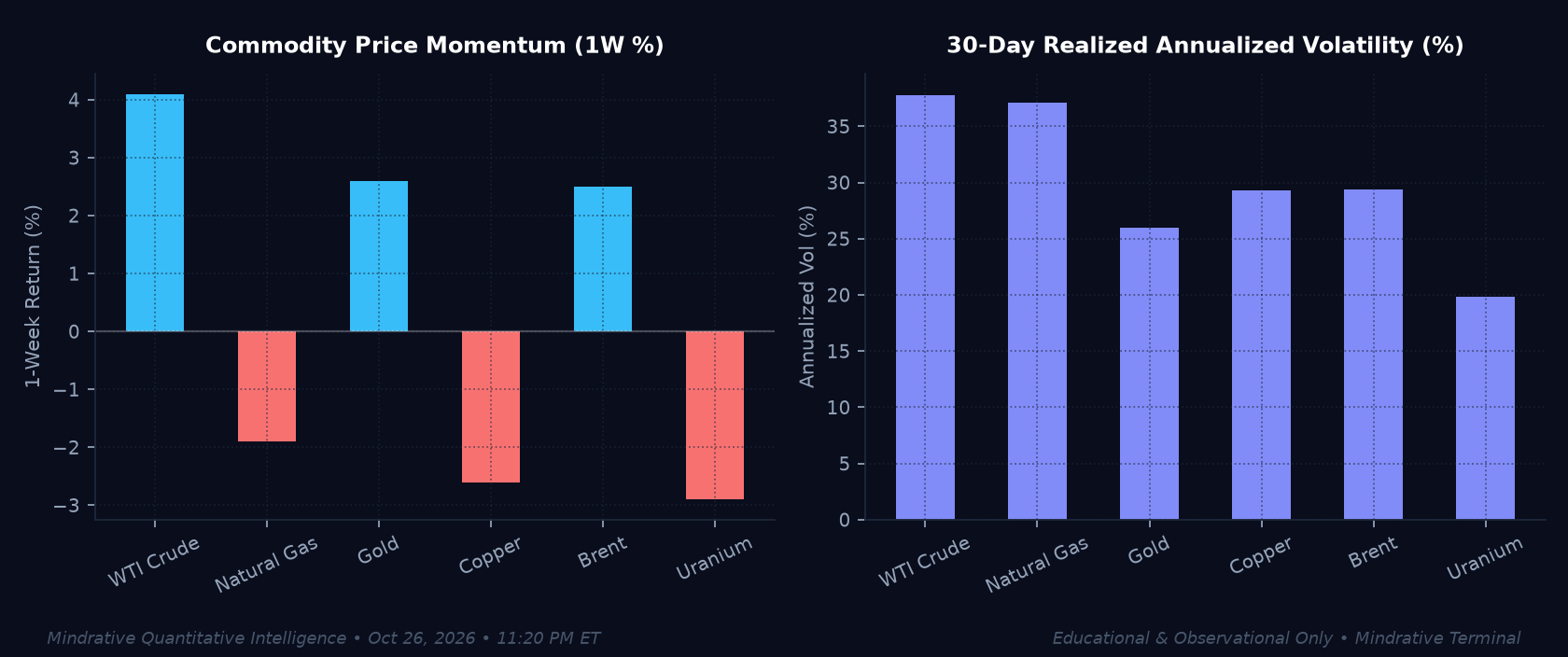
The commodity complex provides direct quantitative evidence of idiosyncratic factor divergence. As illustrated in the relative performance data, momentum profiles across energy, base metals, and nuclear fuel components have decoupled from aggregate macroeconomic cycles:
- Hydrocarbon Volatility: Petroleum benchmarks, including WTI and Brent, have maintained elevated 30-day realized annualized volatilities near the 30% to 38% band. Diplomatic developments concerning Iran illustrate how rapidly speculative risk premia can evaporate, driving localized spot downdrafts despite broader positive trailing-week momentum.
- Cyclical Base Metals: Copper performance continues to reflect headwinds in global industrial demand and fixed-asset construction, posting negative weekly momentum alongside realized volatility approaching 30%.
- Alternative Energy and Uranium: Decoupling from fossil fuels, nuclear fuel feedstock has retraced roughly 3% over the observed trailing week with realized volatility compressing to 20%, reflecting an inventory-digestion phase after prolonged physical market tightness.
In aggregate, these localized dislocations suggest that cross-asset returns are increasingly governed by micro-level policy developments and systemic options-market microstructure rather than broad macroeconomic beta. Institutional risk management frameworks must account for the persistent decoupling between headline volatility indicators and the dispersion observed across individual factor exposures.
Informational only — not financial advice. This digest interprets publicly available information and data for educational purposes and does not constitute a recommendation to buy, sell or hold any financial product. Verify sources and consider your own circumstances before making financial decisions.